
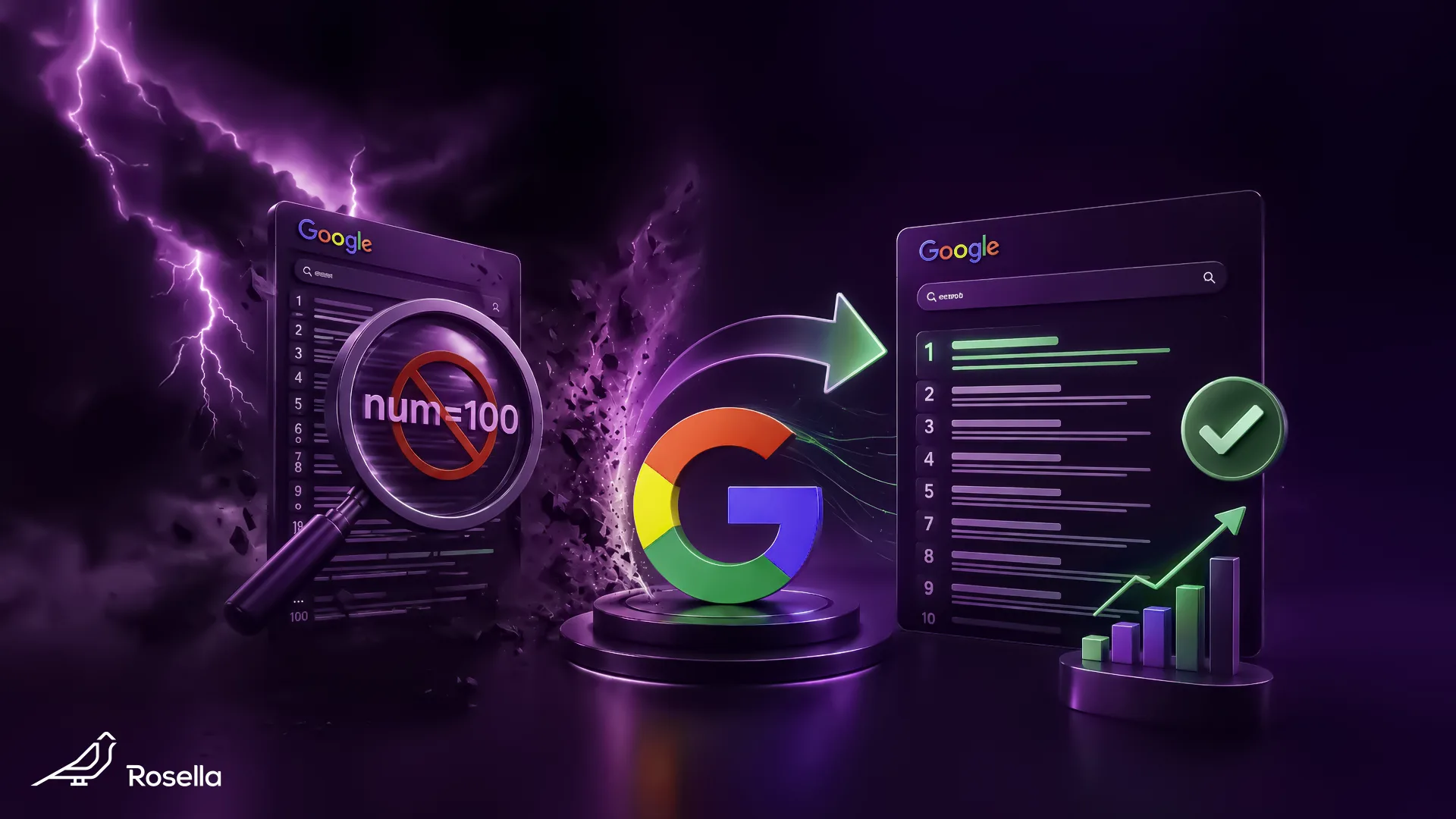
Something quietly broke in the middle of September 2025, and SEO teams felt the tremors long before they understood the source. Dashboards turned red overnight, impression graphs nosedived, and average position figures suddenly looked suspiciously cheerful. The culprit wasn’t any core algorithm update or a manual penalty. It was a tiny URL parameter that Google switched off without notice: &num=100.
What actually disappeared?
For years, anyone could tack &num=100 onto a Google search URL and see one hundred results stacked on a single page. This was instead of the standard ten. It was harmless to regular searchers but vital to SEO tools, rank trackers, and crawlers that used it to harvest deep SERP data in one efficient pull. Then, around September 10-12, the parameter stopped responding.
Google never made a formal announcement. When pressed, the company described it as “not an officially supported feature.” Danny Sullivan later explained that the function was disabled to simplify the search experience and stop automated tools from abusing the system. The decision wasn’t completely random. Google stripped the “results per page” option from search settings in 2018, yet num=100 kept working as a URL parameter until this September, when the loophole was finally closed for good.
The numbers behind the panic
Tyler Gargula, director of technical SEO at LOCOMOTIVE Agency, analyzed 319 properties soon after the change. The findings spread across the industry within days.
- Impressions dropped on 87.7% of sites in Google Search Console.
- 77.6% of sites lost unique ranking terms.
- Short-tail and mid-tail keywords took the biggest hit.
- Fewer queries appeared on page 3 and beyond, while more surfaced in the top 3 and across page 1.
That last bullet is the most telling. Rankings now seem to reflect real positions instead of the distorted picture num=100 produced. The pattern strongly suggests that rank trackers and scrapers had been quietly inflating impression numbers for years by repeatedly pulling 100-result pages. This was done by registering “impressions” for results no human ever scrolled to.
Why were most of those lost impressions not real?
Once the dust settled, a more uncomfortable truth surfaced. A big chunk of that “lost” visibility was never genuine user attention to begin with. Crawls made through the parameter generated artificial impressions in Search Console. Once it was switched off, the data started lining up with how people actually searched.
Picture it this way: if a page sat at position 80 for a query, a tool pulling 100 results would register that as an impression in GSC even though no real searcher ever clicked past page eight. Multiply that across thousands of tools and millions of queries, and inflation adds up fast.
The math behind the updated “improved” average position works exactly the same way. As fewer impressions are reported for pages 2 to 10, the average position figure looks mathematically better. However, no actual ranking improvement has occurred. The 80th-position entries simply vanish from the calculation, leaving only the high-ranking spots, which drags the average up on paper.
What didn’t change?
Here’s the part worth sitting with before assuming the sky has fallen:
- Organic clicks didn’t move. Real people still searched, clicked, and landed on the same pages they always did.
- Click-through rates often climb. When impressions drop but clicks stay flat, CTR percentages naturally rise.
- Mobile data was less affected. Since mobile already uses continuous scroll, num=100 wasn’t really in play there.
If a website’s traffic and conversions held steady through September while its dashboards looked bruised, the business is fine. The reporting is what has changed, not the audience.
Where the real pain shows up?
The actual damage landed on the tooling side. Rank-tracking tools that relied on num=100 for efficient data collection hit immediate obstacles, with broken dashboards, incomplete SERP reports, and temporary tracking outages all becoming common complaints. Semrush, Accuranker, and several others publicly acknowledged the disruptions and rebuilt their collection methods on the fly.
That rebuild costs money. Switching data-collection methods has driven up infrastructure costs for tool providers, and those costs are likely to land on users in the form of pricier subscriptions. Tools now need to crawl ten separate pages to capture the depth they used to grab in one shot. This means more proxying, more compute time, and bigger monthly bills.
The squeeze on small businesses
The teams feeling this most acutely aren’t enterprise SEO departments with redundant data sources. Small and mid-sized businesses tend to lean on affordable tools that take the brunt of the disruption, leaving them with higher operating costs and murkier tracking. Long-tail visibility has narrowed, competitor research has gotten more expensive, and the appetite for paying premium prices to recover that data isn’t always there.
Smaller operators should lean harder on what’s still free and reliable: Google Search Console itself, Google Analytics, and direct conversion tracking. Vanity metrics like total impressions and total keywords just aren’t trustworthy benchmarks anymore.
How to rework reporting in this new reality?
A few adjustments are worth baking into your reporting templates:
- Add a September 2025 footnote. Direct comparisons across the September 2025 boundary can mislead anyone reading the report, so flag the dates clearly. Clients won’t panic if they understand why the chart bends.
- Shift weight to outcome metrics. Clicks, sessions, conversions, and revenue are unaffected by this change and still tell the real story.
- Verify ranking manually for priority terms. Automated tracking has gaps now, and spot-checking your most relevant keywords by hand catches what dashboards miss.
- Lean into long-tail keywords. Specific, intent-rich queries are where conversion gold sits, and they’re less crowded than the heading terms everyone fights over.
The bigger picture
This change fits with a wider pattern. Google has steadily nudged the industry away from a results-list mindset and toward something closer to a recommendation engine. This is where the top few answers carry most of the weight and the long tail of page-three-and-beyond rankings matters less than it once did. The num=100 change just made that shift visible in the data.
Sites that built their performance story around impression counts and keyword totals are rattled. Sites that already measured success by clicks, conversions, and revenue mostly shrugged off and kept moving.
If the impression dip caught your reporting off guard or your rank tracker is still misbehaving, the team at Rosella Digital can help you rebuild a reporting framework that survives the next Google curveball and focuses on the metrics that actually move the business.
Visit Rosella Digital today and book a free SEO consultation to future-proof your search strategy.
Sources:
- 77% of sites lost keyword visibility after Google removed num=100: Data– Search Engine Land
- The Impact of &num=100 Parameter Removal on SEO Reporting– Zeo
- Google Removed num 100 Data: How It Impacts Your SEO Strategy– Timmermann Group
- Google Removed num=100: How SEO Professionals and Developers Can Adapt While Keeping the DEV Community Thriving– DEV Community
- The End of “num=100”: How Google Quietly Reshaped SEO, and the Internet– LinkedIn