
Most of the websites that reach us for a rebuild are not ugly. Many are elegant and carefully art-directed.
They just do not work. They do not rank, they do not convert, and the owner needs a developer every time a phone number changes. They were designed to impress a client in a handover meeting, not to serve a customer searching for a service at eleven at night on a phone.
That distinction is what you should be testing for in any web design company in Saudi Arabia. The question is not how good the site looks. It is what the site will be doing for you six months after launch.
Below are the criteria we would apply, what we build, and how we price it. We will also talk about cost openly, which is the part most competitor pages avoid.
What actually makes a web design company “the best”?
No body awards the title and there is no agreed standard. Any agency can put the phrase in a title tag, and many have.
But four questions expose the level of any web design company within minutes:
- Do they ask about your goals before showing you designs? An agency that sends three templates in the first meeting is selling you a look. A good one asks first: who is your customer, what decision do you want from them, and what makes them hesitate?
- Do they think past launch? Who updates the content? How do you add a new service page a year from now? Who handles backups and security updates? Silence on these questions means you will pay twice.
- Do they build the site to be read by a search engine? URL structure, load speed, heading hierarchy, structured data. These are design and development decisions, and retrofitting them later costs several times what building them correctly costs upfront.
- Do they tell you what they will not do? A confident agency defines the scope and states plainly what falls outside it. Vagueness here is the source of most disputes, and they surface in month three.
Then there is fit. A dental clinic in Riyadh needs six pages that book appointments and rank in maps. A contracting firm needs a project portfolio that builds trust with an engineer comparing three suppliers. A store with a thousand products needs something else entirely. Anyone offering the same solution to all three did not listen.
How to choose a web design company in Saudi Arabia
A practical checklist before you sign anything.
- Open their portfolio on your phone. Not on the laptop screen in their presentation. Then run PageSpeed on two or three of their builds. The results will tell you more than any proposal.
- Ask who owns the site and the code. Who holds the domain? Who holds the hosting? Can you move the site to another provider if the relationship ends? Some agencies build on closed systems that make leaving nearly impossible.
- Ask to see the admin panel. You will live with it for years. If it takes a two-hour training session to change an image, it was designed for the developer’s convenience rather than yours.
- Establish who writes the content. This is where projects stall. The agency delivers a design filled with placeholder text and waits for your copy, and the project slips four months with the delay attributed to you. Agree this in writing.
- Ask what happens after launch. Warranty period, what it covers, and the monthly maintenance cost. Ask now rather than later.
- Is the quote itemised or a single number? A one-line quote is a dispute waiting to happen. Ask for line items: design, development, content, integrations, testing, training.
And one criterion nobody usually mentions: ask about the last project that went wrong and what they did about it. An agency claiming every project succeeded is either not being straight with you or has not worked much.
Why you need Rosella; an agency that understands the Saudi user and Arabic content
Design is a cultural decision as much as a visual one.
The Saudi user browses on a phone in the overwhelming majority of cases and expects speed, because the networks in the Kingdom have trained that expectation. Patience for a ten-field contact form is zero. And there is a clear preference for direct contact channels: a WhatsApp button in the right place can double enquiry volume, a detail no imported template accounts for.
On the content side, literal translation ruins the page. English copy written for another market becomes grammatically clean and commercially inert Arabic that neither uses the phrasing Saudis type nor addresses the objection stopping them from calling.
Then there are operational details that only come from working in the market: pricing in riyals, e-invoicing requirements, a working week that runs Sunday to Thursday in booking forms, and city and district names spelled the way people actually write them rather than the way the map does.
The web design and development services Rosella provides
We work end to end, from planning to launch and beyond. Whether you are looking for a web design company in Riyadh or in Jeddah, projects run remotely on a defined schedule with fixed review points.
Corporate and brochure websites
A corporate site has one job in the first screen: answer what you offer, who it is for, and what happens next. We build a structure that carries the visitor toward that step instead of leaving them to browse.
That includes a standalone page for every service you offer rather than one combined page, which sounds like a detail and in practice multiplies the number of queries the site can appear for. It also includes an About page that builds trust with real names, faces and figures, plus separate landing pages for advertising campaigns.
Ecommerce stores and local payment integration
A store that does not accept mada loses a large share of buyers in the Kingdom. The national payment network alone processed more than 52 billion dollars in ecommerce sales during 2024, growing over 25% year on year, which is enough of a signal about where payments are heading.
What we cover in store projects:
- Integration with mada, Apple Pay and credit cards through a licensed payment gateway.
- Buy-now-pay-later options such as Tabby and Tamara, now expected in many categories rather than a differentiator.
- E-invoicing configured to meet ZATCA requirements.
- Integration with local shipping providers and region-based delivery cost calculation.
- A short purchase path. Every additional checkout step costs you a percentage of orders, and the difference between three steps and five shows up directly in revenue.
Real estate websites and property listing systems
Property sites have a problem no other sector faces: the content disappears. A unit sells, its page is deleted, and two years later the site has lost hundreds of pages that were driving traffic, along with hundreds of broken links.
On a restructure we delivered for a property site, we built permanent hub pages for districts and areas that stay in place and accumulate value, then sub-pages by bedroom count, and connected the live listings to them. Units come and go; the hubs remain. We also built a redirect strategy that sends visitors from a delisted unit to the relevant district rather than to the homepage or a 404.
We also cover the listing system itself: filters, project pages, image galleries, interactive maps and viewing request forms.
Responsive design and mobile experience
We design mobile first, literally. The first layout we draw is 375 pixels wide, and we expand from there.
The reverse order produces what you see across most Saudi websites: menus that work with a mouse and fail on touch, tables that run off the screen, buttons packed close enough to make the wrong one likely, and text sized to force zooming. We treat Core Web Vitals as a delivery condition rather than a later optimisation, because speed is a ranking factor and a conversion factor at the same time.
Arabic language support and right-to-left interfaces
This is where we find the most broken sites, because most templates are built for English and then flipped with a single line of CSS.
The result is a set of small failures that ruin the impression: icons pointing the wrong way, numbers and dates sitting against Arabic text in reversed order, input fields starting from the left, and a low-quality Arabic typeface that makes reading tiring. We treat the Arabic version as an original, and test every component in both directions before delivery.
On bilingual sites we configure structure and hreflang during development. From direct experience building a two-language site on WordPress with WPML: pages created through the REST API register automatically as English even when their content is entirely Arabic. A nineteen-page Arabic build would have reached launch with the wrong language in Google’s eyes were it not for a verification step we added after every creation.
Building the SEO foundation into the design, not after it
The most expensive SEO bill we have ever seen was for a beautiful site built with no consideration for search at all.
What we fix during the build rather than after: a logical and stable URL structure, correct heading hierarchy from H1 down, separate pages per service instead of one combined page, structured data, a sitemap, and Search Console and GA4 configured a week before launch rather than a month after.
We also watch the stage where sites throw away their entire history: migrating from an old site to a new one. On a migration we ran from an old subdomain to a new domain, the project needed a redirect map for every legacy URL, repairs to internal links still pointing at the old address, and re-linking of images whose paths had broken. Launching a new site without those steps means starting from zero while believing you are continuing from where you left off.
Choosing a platform: WordPress, Salla or custom development?
Here is something that may not please some of our peers: most websites in Saudi Arabia do not need custom development. A professional WordPress build covers what most companies need, and custom development is frequently sold because it consumes more hours rather than because it serves the client better.
The realistic options:
- WordPress. Best for corporate sites, content, bilingual builds, and anything whose growth depends on search. You own the site outright and there is no ceiling on optimisation control. In exchange it needs ongoing maintenance and updates.
- Salla or Zid. Best for stores that want to launch quickly. Payments, shipping and invoicing arrive pre-integrated with the local market and operations are far simpler. The trade-off is a ceiling on customisation and on some optimisation details, plus operational dependence on the platform.
- WooCommerce on WordPress. A middle path for stores where a large share of demand comes from organic search and full control over content and structure matters.
- Custom development. Genuinely justified when the operational logic is the product: complex booking platforms, internal management systems, bespoke integrations. Not justified for a twenty-page site.
And a professional admission: page builders like Elementor and Divi add weight that slows the site, and we still use them on some projects. The reason is that they give the client genuine ability to make their own edits, which is an operational value sometimes worth a few points on a speed test. The decision is made per project, and we explain the trade-off before we start.
How Rosella works: from planning to launch
- Discovery and planning. A session to understand your business, your customer and your goals, a competitor review, and a written scope. The output is an approved sitemap before anything is drawn.
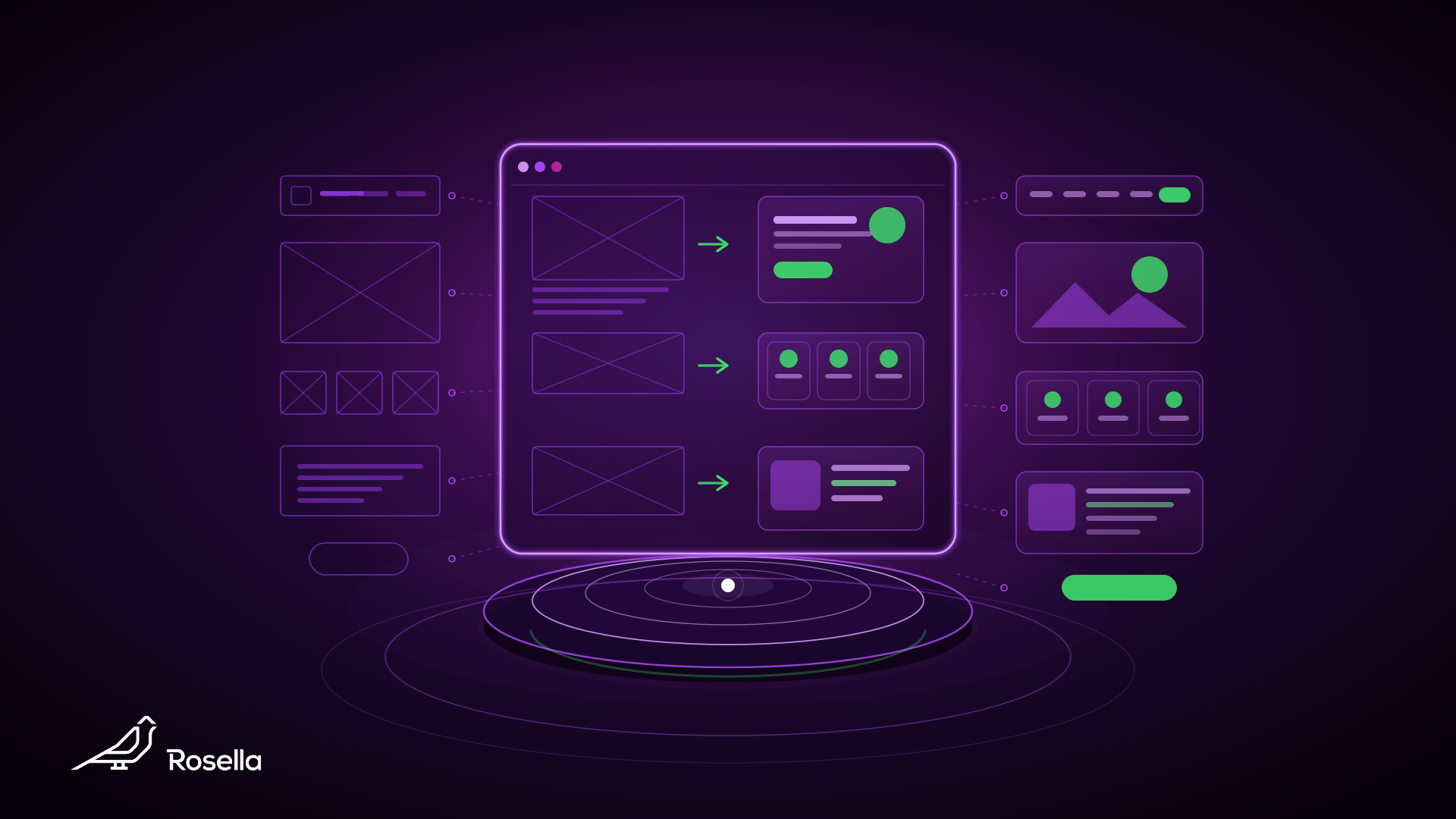
- Structure and wireframes. Wireframes for the main pages with no colour and no imagery, so we agree on the logic before the look. This stage halves the number of review rounds later.
- Visual design. Full design of the core pages in desktop and mobile versions, within two defined review rounds.
- Content. Arabic copy written for search and conversion, or editing of what you already have. If you would rather save that line item, we give you a written framework for each page to write inside.
- Development. Build on the agreed platform, with the SEO foundation and required integrations.
- Testing. Across browsers and devices, forms and payment testing, speed checks, and a component-by-component review of the Arabic direction.
- Launch and handover. Redirects from the old site where one exists, analytics connected, all access credentials handed over in your name, and a recorded training session on the admin panel.
Selected Rosella work
- A landing page for a listed workforce solutions company. Built within the brand identity and approved palette, with a single clear conversion path.
- A site migration from a subdomain to a new domain. A full redirect map, internal link repair and image re-linking, with a post-launch technical audit.
What determines the cost of a website in Saudi Arabia?
The most common question we receive, and the one competitor pages answer least.
Prices circulating in the Saudi market fall roughly into these bands: a simple brochure site between 3,000 and 6,000 riyals, a professional corporate site between 6,000 and 15,000, an ecommerce store between 10,000 and 30,000, and custom projects or systems starting at 30,000 and sometimes passing 100,000 riyals. The range is wide because the word “website” describes entirely different things.
The factors that actually move the number:
- Page count and variety. Twenty pages from one template cost far less than eight pages each with a different layout.
- Custom design versus adapted template. The single largest differentiator in cost.
- Content. Are you writing it or are we? Does it need translation or a second language version?
- Integrations. Payments, shipping, invoicing, booking systems, internal system connections. Each integration is a job in its own right.
- Photography and identity. Real images of your premises and products raise the cost and raise conversion with it. Stock imagery is cheaper and looks it.
Practical advice: be wary of the cheapest quote you receive. Three thousand riyals for a “complete” website usually means an off-the-shelf template with translated copy, no testing and no support, and you will pay the difference a year later in the form of a rebuild.
Maintenance and support after launch
A website is a living product. It either gets maintained or it degrades quietly.
Our maintenance package covers:
- Platform and plugin updates, with conflict monitoring after each one.
- Scheduled off-server backups, with restoration actually tested rather than merely assumed.
- Security monitoring, SSL, and form spam protection.
- Speed and uptime monitoring, with broken links fixed as they appear.
- Monthly content edits within an agreed number of hours.
If you would rather manage the site yourself, that is a perfectly legitimate choice. Just agree who does what before launch, because the worst outcome is a site nobody is watching because each party assumed the other was.
Red flags in web design proposals
When comparing web design companies, stop at any of these.
- A one-line quote. “Complete website: 8,000 riyals.” Complete meaning what exactly?
- No written scope. Page count, number of review rounds, delivery timeline, and what falls outside. Its absence is the source of most disputes.
- Hosting and domain in the agency’s name. Both should be yours. Otherwise your exit depends on their cooperation.
- Portfolio work that does not open. Images in a slide deck with no live links. Ask for the link, and if you are told the client took the site down, ask for a different one.
- “Your site will be ready in three days.” Technically possible. It means a template filled with translated text, with no planning, no original content and no testing.
- Overreaching SEO promises inside a design quote. “SEO-optimised and guaranteed to rank.” The technical foundation is built during design; ranking is ongoing work after launch, and nobody guarantees it.
- Complete silence about the post-handover phase.
Get a quote for your project
Send us your project and we will come back with an itemised proposal rather than a single number.
The proposal includes:
- A written scope covering page count, review rounds and delivery timeline.
- A platform recommendation for your situation, with the reasoning behind it.
- The monthly maintenance cost after launch, stated upfront.
- A quick review of your current site if you have one, with the priority fixes.
FAQ
How much does a website cost in Saudi Arabia?
Market rates run roughly from 3,000 to 6,000 riyals for a simple brochure site, 6,000 to 15,000 for a professional corporate site, and 10,000 to 30,000 for an ecommerce store. Custom projects start around 30,000 and can exceed 100,000. The biggest differentiators are custom design versus an adapted template, and who writes the content.
WordPress, Salla or custom development?
WordPress covers most corporate sites and anything whose growth depends on search. Salla and Zid suit stores that want a fast launch with payments and shipping already integrated locally. Custom development is only justified when the operational logic is the product, such as a complex booking platform or an internal management system.
How long does a website take, and why do projects slip?
A corporate site usually takes four to eight weeks and a store takes longer. The leading cause of delay is not development but content: designs get delivered with placeholder text while everyone waits for the client’s copy. Agree in writing who writes the content and by when before the project starts.

